
Finding Mount Juliet Residents
Mount Juliet is a city in western Wilson County, but many records that help locate people are held in Lebanon, the county seat. Begin with the question, not a broad name search. An owner question starts with a parcel card. A registration question uses the state voter form. A past-household question belongs with deeds, newspapers, directories, and Archives material. The city and county do not maintain one complete household roster, so each source must be read for what it actually proves.
An assessor card can connect an owner to a parcel, while a deed can document a recorded transfer. A voter result confirms only one registration match. A court party may have a case in Wilson County without living in Mount Juliet. Keep the record date and source with every result. That habit helps where a postal label, a city limit, and a county office do not line up.
- For a current address, search the assessor card and record the parcel number, owner name, transfer reference, and mailing address.
- Open the parcel viewer to check the address point, subdivision, city limits, and the office that may hold a related file.
- Use the deed volume and page, or the legal description, to follow recorded ownership in WilsonDeeds.
- For an individual registration check, use the required county, first name, last name, birth month, and birth year.
- For a former household, ask the library or Archives for the exact holding, then compare it with deeds, probate, and newspapers.
Note: An owner, a voter, and a court party are different kinds of evidence and should never be combined into an assumed household list.
Mount Juliet Records Begin in Wilson County
Mount Juliet City Hall is at 2425 N. Mt. Juliet Road, while the core county offices sit in Lebanon. That split matters when a search changes from a city report to a property, deed, probate, election, or archive record. The City Hall route is useful for city-held material and its public-records process. The county route is usually the better starting place for land, tax assessment, recorded instruments, and older county files.
Use the office that owns the record rather than asking one office to assemble a new resident list. Tennessee's Public Records Act, T.C.A. §§ 10-7-501 et seq., gives a Tennessee citizen an inspection path for existing nonexempt records. Under § 10-7-503, a custodian that cannot promptly produce a record must provide it, deny it in writing, or state the reasonable time needed within seven business days. A narrow request naming an address, date range, or record type is more useful than a request for every person in a neighborhood.
Search Mount Juliet Parcels Through TPAD
The Tennessee Property Assessment Data search is the public search surface for a Wilson County parcel. It accepts an address, owner name, or parcel ID, then exposes more choices in Advanced Search. The county says it maintains about 53,000 parcel cards and updates web-viewable assessor data weekly. That makes TPAD a strong first stop for a current property question, but it remains a property record rather than a list of all residents.
The displayed card can show a situs address, owner names, a separate mailing address, parcel ID, subdivision and lot, dimensions or acreage, improvement details, classification, values, and transfer details. The assessor's public terminal is a fallback when the online search is awkward. For a full address-by-address process, the Mount Juliet by-street directory follows the parcel, map, and recorded-deed trail without treating an owner card as a household roster.
The TPAD property search shows the statewide interface used to begin a Mount Juliet property check.
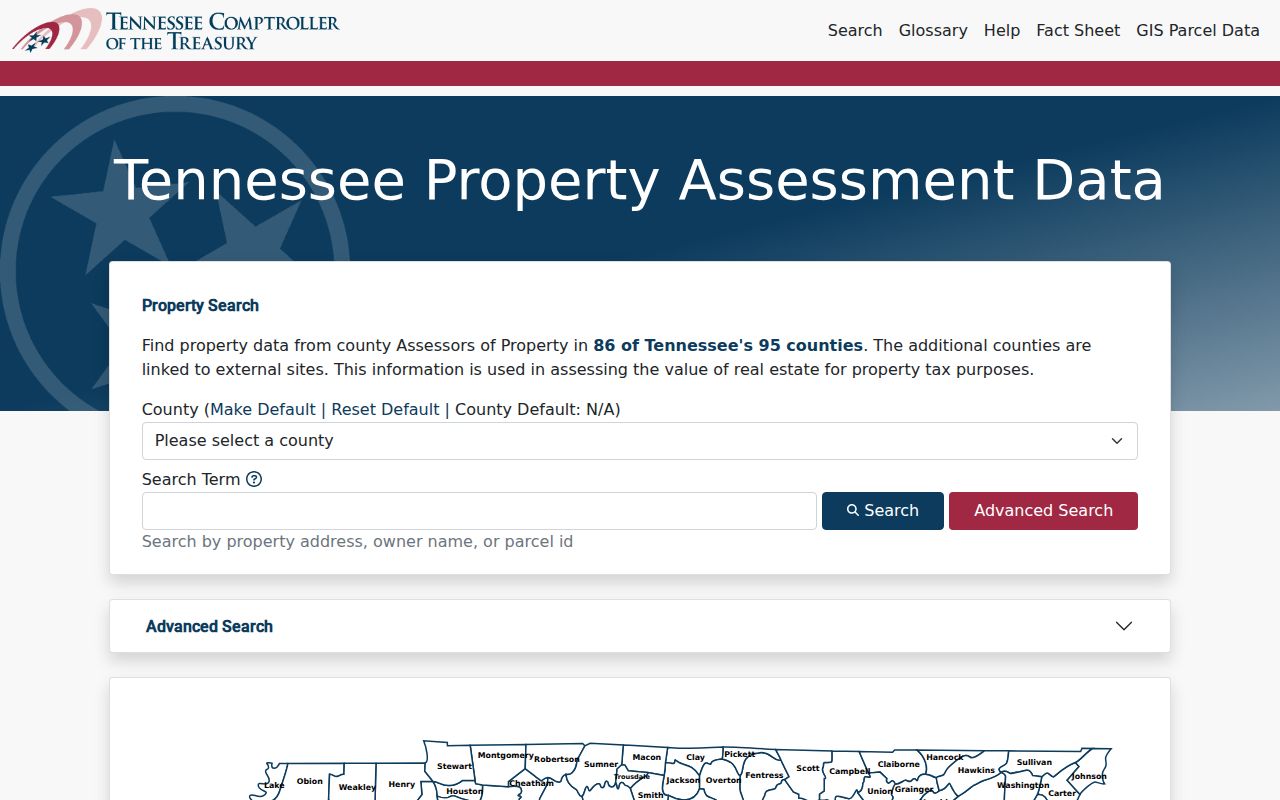
A property result should be saved with its search date, because weekly assessor refreshes can change what the public view displays.
| TPAD field | How it helps a Mount Juliet search | Format or option |
|---|---|---|
| County | Selects the Wilson County record set | Selector |
| Search Term | Runs a basic address, owner, or parcel query | Text |
| Owner Name | Finds the named assessor owner | Text, such as a full or abbreviated name |
| Property Address | Finds the parcel situs | Street number is optional |
| Subdivision Name | Bridges a modern address to a plat | Text |
| Classification | Limits a property category search | Selector |
| Sale Date Start and End | Limits transfer timing | Optional date pair |
| Control Map, Group, Parcel | Uses assessment-map components | Text components |
| Sort By | Orders a result set | Owner, address, parcel, subdivision, classification, or sale date |
Verify Mount Juliet Voter Records
The Tennessee Voter Registration Lookup is a confirmation form, not a browseable resident roll. A Wilson County check needs five fields: county, first name, last name, birth month, and birth year. Enter the name as it appears on the voter card. A no-record message calls for a spelling check and, if needed, contact with the Wilson County Election Commission. It does not show every voter near an address.
Public voter material has redaction limits, including Social Security, driver-license, and Department of Safety identification data. Tennessee does not register voters by party. The county can provide digital lists by precinct, municipality, school district, county, or state legislative district, but its ordering information says those lists are for political use only under T.C.A. § 2-2-138. That product is different from the five-field individual lookup.
The Wilson County voter-list ordering page distinguishes the county request route from an individual registration confirmation.
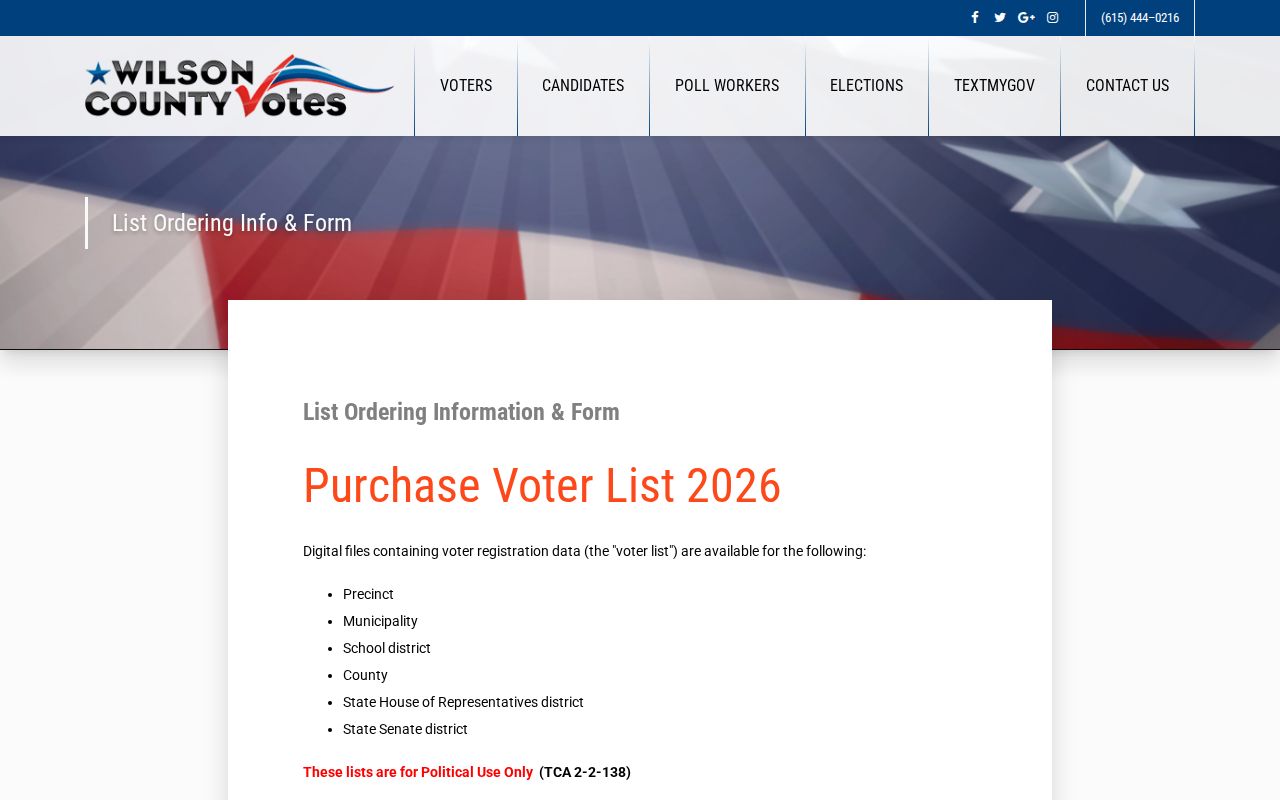
The ordering material is useful for understanding access limits, but it does not turn the state lookup into a block or household search.
| Required lookup field | Entry guidance |
|---|---|
| County | Select Wilson County for a Mount Juliet registration check. |
| First Name | Use the name recorded on the registration. |
| Last Name | Use the recorded surname and test a variant if needed. |
| Birth Month | Select the month from the form. |
| Birth Year | Select the year from the form. |
Note: A no-record result may reflect formatting, a move, list maintenance, or protected-program handling rather than proof that a person is absent.
Trace Mount Juliet Names in WilsonDeeds
The Wilson County Register of Deeds search can turn a parcel transfer reference into a recorded ownership trail. Its published availability ladder is important. Deed images are reported as image-only back to 1793. Searchable index-and-image material begins in November 1984, and scanned index books can be browsed back to April 1925. The online inquiry account costs $35 a month. A missed name search is not proof that an older deed has vanished.
Start from the assessor's deed volume and page or legal description. Then compare the grantor, the party conveying an interest, with the grantee, the party receiving it. Search the seller as an earlier buyer and keep the parcel, lot, and legal description aligned. Plats can bridge an address to a lot or subdivision, but plat books P9 through P17 require browse-by-book and page because they lack an index database.
The published WilsonDeeds material supports the following record inventory. The live result screen and its exact labels were not available in the inspected text, so verify the current screen before quoting a field name or search option.
- Party names, including the grantor and grantee roles.
- Instrument type and recording date.
- Book and page or document number.
- Legal description and related parcel or subdivision information.
- Image availability for the recorded instrument.
- Grantor
- The party conveying a recorded property interest.
- Grantee
- The party receiving that recorded interest.
- Legal description
- The deed's land description, stronger than a mailing label for matching a parcel.
- Recorded instrument
- A deed, lien, plat, or other document filed with the Register of Deeds.
Mount Juliet Resident Records Offices
Three offices form the practical core of most current Mount Juliet searches. The Register connects people to recorded land instruments. The Assessor describes the parcel, owner, and transfer reference. The Election Commission oversees voter access. All three are Wilson County functions, so their main offices are in Lebanon even though Mount Juliet has city offices and a county clerk location on Lebanon Road.
Use the city for city-held police, permit, or planning records, and use county custodians for county records. The City Hall process does not replace a county land or election request. A request should identify the existing record sought and allow for redaction or a nonpublic category.
Wilson County Assessor of Property
228 E. Main Street, Room 4
Lebanon, TN
615-444-8661
Wilson County Election Commission
230 E. Gay Street
Lebanon, TN 37087
615-444-0216
Current Mount Juliet Resident Directories
Current sources have different scopes. The assessor is strongest for a named owner and property. The voter form checks one possible registrant. WilsonDeeds shows parties to an instrument. City staff and community pages may identify public contacts, but neither is a public roster of Mount Juliet households. A useful search labels the source type rather than pretending each source lists the same people.
| Current source | What it can establish | Custodian | Access route |
|---|---|---|---|
| Assessor parcel card | Owner, parcel, mailing address, and transfer reference | Wilson County Assessor | TPAD or public terminal |
| Voter confirmation | One registration match and county context | Tennessee and Wilson County elections offices | Five-field state form |
| Recorded instrument index | Grantor, grantee, document, date, and legal-description trail | Wilson County Register of Deeds | WilsonDeeds account, book browse, or office |
| City staff directory | Public city departments and officials | Mount Juliet city government | Online city directory |
| Community association material | Public board, manager, documents, and neighborhood contacts | Association or community custodian | Public material only; member areas may be restricted |
A different mailing address on a parcel card may belong to an owner, trust, estate, business, or an older correspondence route. It does not identify unnamed people at the situs. Keep that limitation in view when comparing current records with a later voter confirmation or an older directory entry.
Note: A property card describes an assessed parcel, while a registered-voter match and a recorded deed each answer narrower, different questions.
Check Mount Juliet Court Names Carefully
Wilson County trial courts are reached through local clerks for Circuit Criminal, Circuit Civil, General Sessions, Family, Juvenile, and Chancery or Probate matters. A court entry can be a useful lead, but the party role matters. A plaintiff, respondent, executor, attorney, or witness is not automatically a Mount Juliet resident. Ask the clerk for the case number, court, filing date, type, and disposition before requesting the right document.
The local Tennessee Case Finder landing page is a restricted government login, so it did not expose an anonymous public name search. The official Tennessee appellate case-history search is a separate public tool for appeals filed after September 1, 2006. It offers case-number, case-style, party-name, and business-organization modes. Trial files still belong with the local clerk, and protected, juvenile, sealed, and other nonpublic court material remains outside an ordinary name search.
The appellate case-history search displays the public search choices relevant to a local court lead.
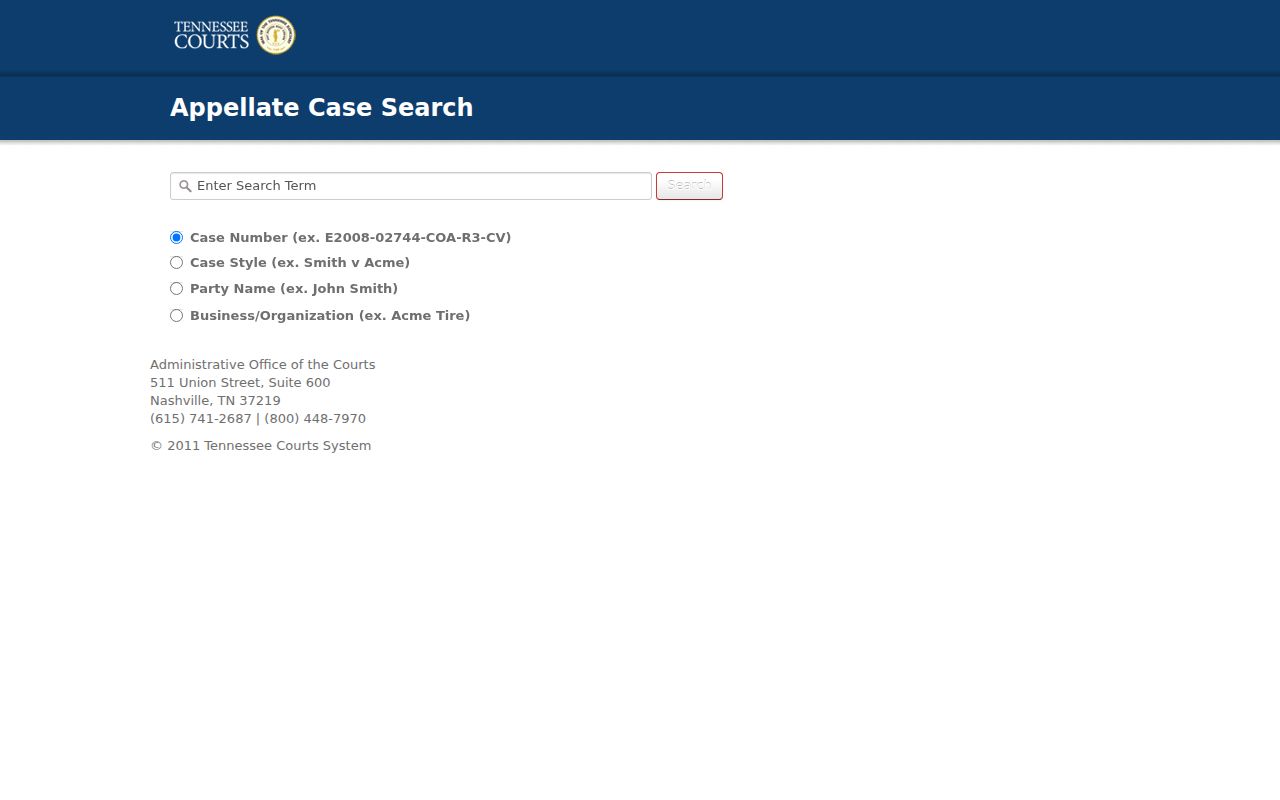
Use an appellate name match to obtain a case number and procedural trail, then verify the person and originating court before relying on it.
A public appellate result may include the case number, case style, party name, organization, procedural history, status, linked motions, orders, judgments, opinions, and a currentness note. The party name is a search key, not identity proof.
Mount Juliet Vital Records Have Time Limits
Tennessee Code Annotated § 68-3-205 sets a clear historical line. Birth records remain with Vital Records for 100 years. Death, marriage, divorce, and annulment records remain there for 50 years. Older qualifying records become public through the Tennessee State Library and Archives. Recent certified copies require the appropriate applicant relationship, identification, and fee, so a person search should not assume that every family record is open.
Birth and death certificates can be issued statewide through county health departments, in person, by mail, or online through the authorized ordering route. Wilson County's clerk and Register of Deeds handle local marriage-license material, while older county records can also lead to the Archives or TSLA. The state application index distinguishes the forms: PH-1654 for birth, PH-1663 for death, PH-1670 for marriage, and PH-1671 for divorce or annulment.
The Tennessee Vital Records applications index groups the official forms used for a Mount Juliet family-history request.
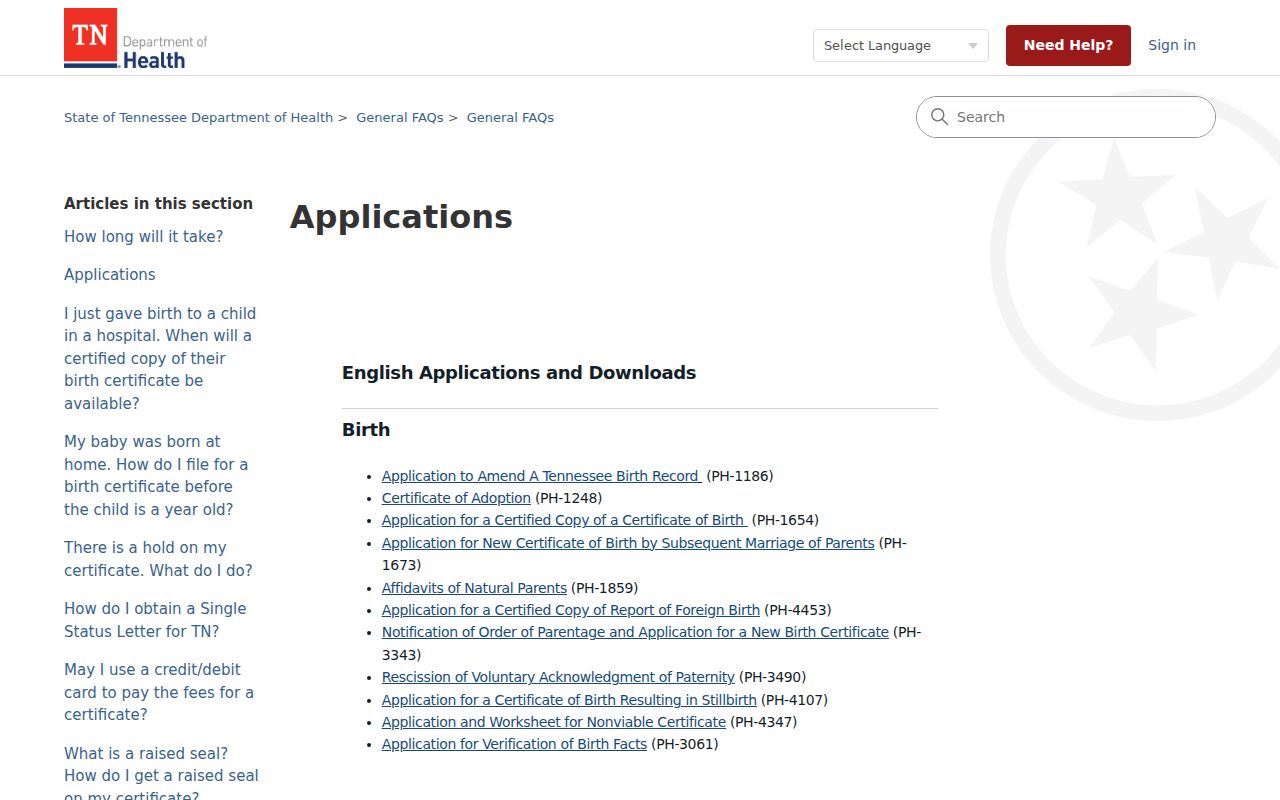
The form page is an access starting point, not a substitute for the eligibility and identification requirements attached to a recent certificate.
- Birth form PH-1654 asks for identifying birth details, parents, requester relationship, purpose, and delivery details.
- Death form PH-1663 asks for decedent details, death information, requester relationship, and a cause-of-death selection.
- Marriage form PH-1670 asks for both partners' names, the license place, date and place of marriage, and requester details.
- Divorce form PH-1671 asks for both spouses' names, divorce date and place, requester relationship, and delivery details.
Mount Juliet Archives Bridge Record Gaps
Mount Juliet became a city in 1972, while Wilson County was formed in 1799. Earlier people and property references may be filed under Wilson County, Lebanon, Rutland, Green Hill, Suggs Creek, or another local community name rather than a modern city label. Wilson County Archives at 111 S. College Street in Lebanon is the main local fallback for that older county context.
The Archives reports county microfilm from 1802 to 1965 and loose county records from 1799 to 1965. Its holdings include court, probate, marriage, election, school, merchant-license, mortgage, road, manuscript, and family material. The documented 1881 courthouse fire is a reason to cross-check there, with TSLA finding aids, published indexes, church records, and catalog entries. The research does not identify a precise list of volumes lost in the fire, so no missing book should be assumed without an archivist's confirmation.
Wilson County Archives provides the local collections and research-room information used to extend a Mount Juliet trail beyond online indexes.
The Archives lists a public research room and mail research. Its stated mail charge is $5 for up to five pages or $15 for research up to 20 pages. The Mt. Juliet–Wilson County–Harvey Freeman Memorial Library is a practical local starting point for interlibrary loan, yearbook questions, and checking the exact title, years, call number, and access restriction of a historical holding.
Note: A catalog record can identify a useful book or reel, but it does not establish that a digital image is available to the public.
Historical Mount Juliet Resident Directories
Historical evidence around Mount Juliet is more varied than a single run of printed city directories. Confirmed leads include the Lebanon business directory from 1869 through 1876, a Lebanon city directory from 1927, Mount Juliet weekly and commercial publications from 1915, later newspaper runs, and cataloged school yearbooks. A directory entry can provide a name, spouse or widow notation, occupation, business affiliation, address, and ownership or tenancy notation, but the exact local entry format must be checked in the selected volume.
For an older household, record the name and address in one source, then compare the next available year with a deed, census, obituary, probate file, or school record. The Archives and library are the fallback when a digitized scan is not advertised. A historical volume can omit rural residents or list a business contact rather than a whole household, so the Mount Juliet trail needs more than one source.
The Mount Juliet city directories collection page concentrates on those shelves, catalogs, newspapers, and the ways a historical entry can be read.
Mount Juliet Permits Need the Right Custodian
The city planning department has announced a self-service route for permits and project submissions. City construction records can add dates, project descriptions, applicant or owner information, inspections, and occupancy material when those fields are public. The public pages do not expose a complete permit-by-address result screen or a historical retention schedule. For a city address, ask the city department; for an unincorporated address or an earlier jurisdiction, check the county construction office.
For an existing city-held record that is not publicly searchable, use the City of Mount Juliet's TPRA process. Its FAQ says the city determines whether disclosable records exist within 10 days, while the state statute sets the custodian's seven-business-day response choices when prompt production is not practical. Inspection at City Hall is free under the stated policy; copies and labor can involve charges. Ask for a permit file, project number, inspection record, citation, or report by exact address and date range.
The Mount Juliet NextRequest FAQ shows the city public-records route for a specific document rather than a request to create a new residents list.
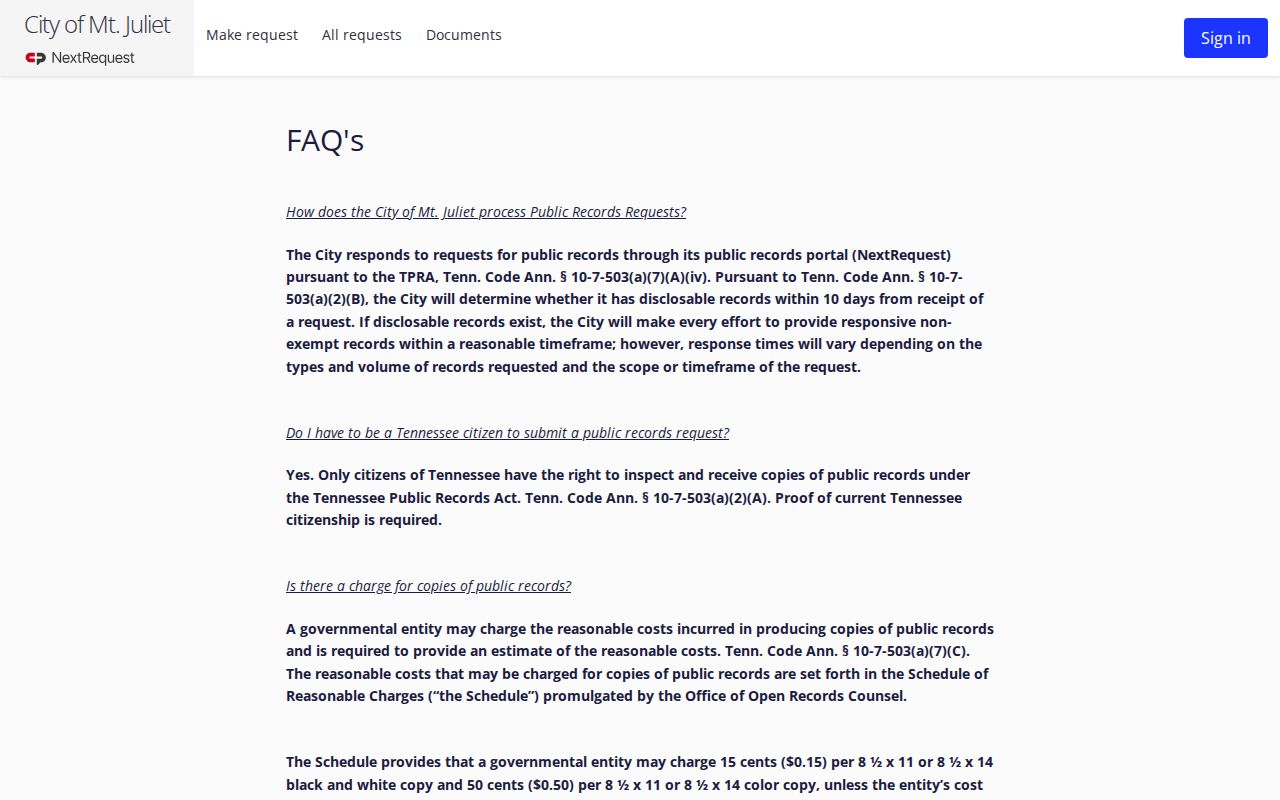
Keeping the request narrow helps the city identify a responsive record, estimate any allowed cost, and explain any redaction or timing issue.
Note: City planning jurisdiction can change after annexation, but the Wilson County parcel and recorded-deed trail remains the key land-record continuity link.
Mount Juliet Records Are Not Households
A common mistake is to treat several public hits as a complete list of people at an address. They are not. An assessor card can show an owner and mailing address, but not every occupant. A voter lookup is one-person confirmation. A deed records parties to a transaction. Utility customers, unlisted household members, protected addresses, sealed court files, current restricted vital records, and private association member areas are not ordinary resident-directory material.
Tennessee Safe at Home provides a substitute address for qualifying participants but does not erase existing records. Motor-vehicle personal information has separate federal limits, and voter identifiers are redacted. Use public records for lawful personal, family-history, civic, property, and safety purposes. Do not use a result to stalk, harass, threaten, or harm anyone.
| Official-record path | Commercial people-finder category |
|---|---|
| Names the custodian, record type, access channel, and date of the record. | May combine public, marketing, and user-supplied data with varying freshness and matching quality. |
| Allows a parcel, deed, voter, or court result to be checked at its source. | Can provide a lead, but should not replace verification with the office that holds the record. |
| Shows known legal and access limits for that specific record. | Removal and privacy practices vary, and one service does not control official public records. |